

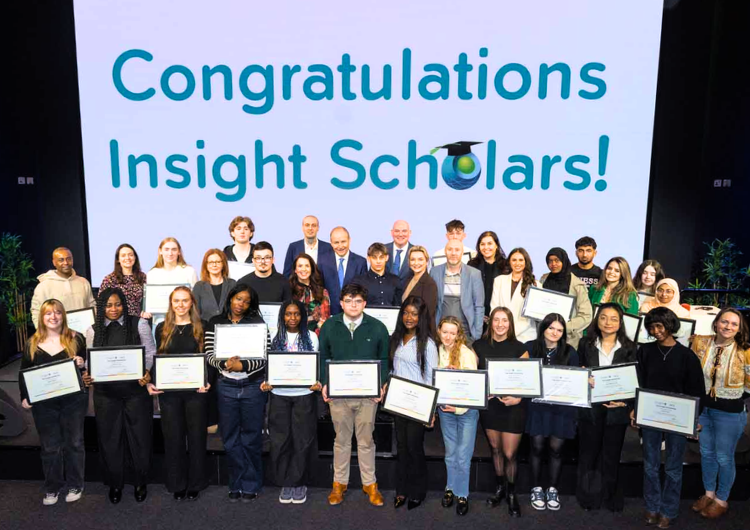
TAOISEACH PRESENTS AI SCHOLARSHIPS TO STUDENTS AT GOOGLE HQ
Largest fund of its kind in Ireland supports underrepresented students in STEM courses
March 5 2026, Dublin: Taoiseach Micheál Martin will today present 25 students from underrepresented backgrounds with scholarships to study a range of STEM courses, such as AI and cybersecurity, as part of the second phase of the Insight Research Ireland Centre for Data Analytics Scholarship Programme, supported by Google.org and coordinated by Dublin City University (DCU).
The event will take place in The Foundry, Google Ireland, Barrow St, Dublin 4.
Students set to receive scholarships today include members of the Traveller community, students who have been in the care of the state, students with disabilities and refugee students.
The Insight Scholarship Programme, supported by Google.org, is the largest scholarship programme of its kind in Ireland. With a funding package of €1.5 million over five years, two cohorts of undergraduate students will receive scholarships to study in one of 230 STEM courses across 12 Irish universities.
Forty two students entered the programme in the first cohort in 2024. A further 25 will be presented with certificates by the Taoiseach at today’s event. Scholars will be awarded €5,000 per year, up to a maximum duration of five years.
Last year’s scholars are now studying STEM courses, with dedicated mentoring support, across 12 Irish universities. Insight scholars come from a wide range of backgrounds including the Traveller and Roma community, those who have experienced homelessness, students with disabilities, students who have been in State care, refugees and lone parents.
Additionally, 60% of the scholars are women pursuing STEM degrees—more than double the national average, where women represent only 33% of STEM students in Irish universities.
Taoiseach Micheál Martin said:
Taoiseach Micheál Martin said:
‘Education is one of the most powerful tools we have to build a fairer, more inclusive Ireland. These scholarships represent far more than financial support; they are an investment in talent, ambition and potential that exists in every community across our country. By widening access to AI, cybersecurity and other STEM disciplines, we are ensuring that the opportunities of the digital age are open to all, not just a few. I want to congratulate each of today’s scholars on their wonderful achievement. I also commend Insight, DCU and Google for their leadership in creating the largest scholarship fund of its kind in Ireland. Together, we are strengthening Ireland’s future as a global leader in innovation while ensuring that no one is left behind.’
Professor Noel O’Connor, Insight CEO, said:
‘We are so proud of the 42 Insight scholars now thriving in their STEM studies across the country. These smart, ambitious students are the best expression of Insight’s vision; to empower critically aware, creative communities and create a better society for all. This initiative has shown us not only what is possible, but also how urgently programmes like this are needed to drive equity, diversity and inclusion and ultimately to strengthen Ireland’s and Europe’s future in AI. We warmly welcome the new cohort of Insight scholars joining us today and wish them and their mentors every success.’
Vanessa Hartley, Head of Google Ireland Google said:
‘Google is proud to support the Insight Scholarship Programme, representing a €1.5 million contribution to Ireland’s future tech talent pipeline. By focusing on AI and digital safety, this scholarship directly addresses the growing need to ensure equitable access to these essential skills, driving a stronger and more diverse foundation for Ireland’s economy.’
Programme Coordinator Megan Griffin said:
‘This programme is designed to support students from underserved communities that have long experienced limited access to opportunity, recognising that the barriers they face extend beyond financial disadvantage. Many of our students come from areas with historically low progression rates to higher education, with some disadvantaged communities seeing only 15% of students entering university compared to over 80% in more affluent areas. Students from more affluent backgrounds also continue to dominate high-points courses, with less than 5% of entrants coming from DEIS schools. Tackling these inequalities in access to STEM education is vital for the growth of both our economy and our society.’